


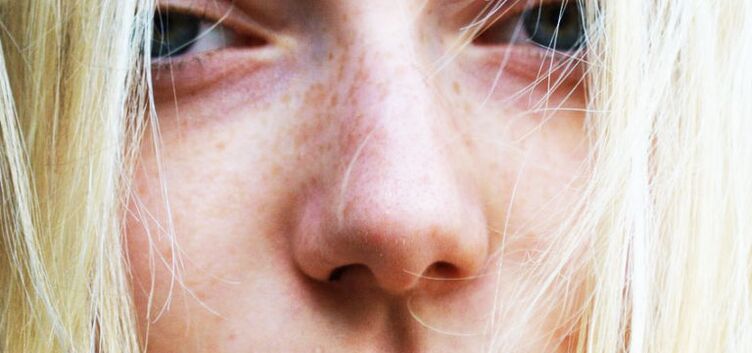
Non-surgical rhinoplasty is an innovative method of correcting minor nasal defects.This is an excellent alternative to plastic surgery and a unique opportunity to improve your appearance without resorting to a surgeon's scalpel.A quick and painless method, which is based on the injection of special gels (fillers), allows you to give the nose the desired shape.
The great advantage of the procedure is that, unlike surgery, the shape of the nose does not change forever.And if you do not like the result of rhinoplasty, after six months the nose can be adjusted again according to the client's wishes.The procedure is completely safe, is performed under local anesthesia and lasts only 30 minutes.Let's find out what the main advantages of non-surgical rhinoplasty are, what its characteristics are and how the procedure takes place.
Non-surgical rhinoplasty: the essence of the procedure.
Non-surgical rhinoplasty is considered the gentlest cosmetic procedure, with which small imperfections can be eliminated and the shape of the nose corrected.The use of this method allows you to eliminate minor defects: correct the shape of the nose, level its surface and smooth out irregularities.
Many patients who seek help in cosmetology clinics are dissatisfied with the shape of their nose.But not everyone decides to undergo surgery and not everyone has the financial resources for radical plastic surgery.Many people just want to slightly correct imperfections and smooth out minor defects.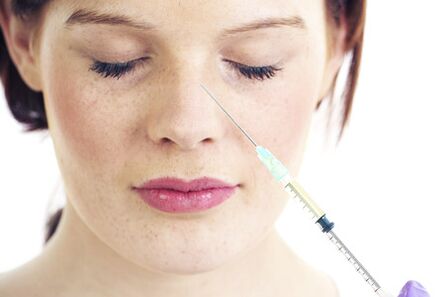 Therefore, cosmetologists have developed an alternative method that allows solving the problem without significant material costs or traumatic intervention.
The essence of the procedure is that special substances (fillers) are injected under the skin into problem areas with a needle.Fillers are plastic implants, completely safe and adapted to the human body.With its help you can fill irregularities, level protuberances and make the desired shape correction.There are other non-surgical intervention options using threads, hormonal drugs or adipose tissue.It all depends on the patient's individual preferences and characteristics.
Cosmetologists warn that it is impossible to radically change the size and shape of the nose without surgery, but minor defects can be corrected.At the same time, the result of the procedure is not permanent, it lasts a maximum of one year, after which it will be necessary to repeat the correction.This also has its advantages.If the initial result is not completely satisfactory, next time you can make additional corrections to achieve the desired effect and the ideal shape of the nose.

Indications
In which cases can you resort to non-surgical nose rhinoplasty?Cosmetologists recommend the procedure to eliminate the following deficiencies:
- nasal asymmetry;
- uneven relief (depressions, tubercles);
- slight hump on back of nose;
- acute angle of the bridge of the nose;
- concavity of the nasal bridge;
- small defects on the tip of the nose;
- consequences of mechanical trauma;
- elimination of age-related changes (wrinkles, sagging skin);
- correct the consequences of a failed operation.
All of these deficiencies can be easily eliminated with non-surgical rhinoplasty.But, like any cosmetic procedure, this method has a series of contraindications that should be taken into account when deciding whether the procedure is necessary.
Contraindications
Despite the simplicity and safety of the innovative method, the nose correction procedure has contraindications that cosmetologists divide into two groups:
Absolute contraindications:
- autoimmune diseases;
- allergic reactions to the medications used;
- diseases of the endocrine system (diabetes mellitus, hypo or hyperthyroidism);
- hemophilia and other bleeding disorders;
- tendency to form keloid scars;
- oncological diseases;
- the presence of bionon-degradable filler in the revision rhinoplasty area;
- pregnancy and lactation period.

If you have any of these conditions, non-surgical rhinoplasty cannot be performed.
Relative contraindications:
- colds (ARVI, flu);
- viral infections (herpes);
- inflammatory process on the skin of the nose area;
- menstrual period;
- exacerbation of chronic diseases;
- Recent cosmetic procedures (skin rejuvenation or exfoliation).
After the elimination of painful conditions and complete restoration of the skin after rejuvenation procedures, it is allowed to perform nose correction by a non-surgical method.
Types of fillers for non-surgical rhinoplasty
There are four main methods used for non-surgical rhinoplasty:
- Non-surgical rhinoplasty with fillers.Special gel implants are inserted under the skin in the nose area to smooth the surface and correct minor imperfections such as a slight asymmetry, a hump, or a drooping tip of the nose.This type of plastic surgery does not require any incision in the skin and there are no traces left after its performance.Medications are administered through targeted injections and the use of local anesthesia makes the procedure painless and comfortable.During the procedure, popular gel fillers are used.This method is considered the safest, it has a minimum of contraindications and its effectiveness and durability of correction largely depends on the type of filler.The duration of the procedure is only 15 to 30 minutes, after which the patient goes home with a "new" nose.
- Rhinoplasty with hormonal drugs.Injecting hormonal medications allows you to dissolve excess soft tissue and eliminate bumps or irregularities.This method is most often used to correct the wings and tip of the nose.To eliminate pain, an anesthetic is added to the preparations.This technique requires a careful approach and extensive experience, since the main difficulty lies in calculating the required volume of hormones.
 Incorrect choice of drug dose can cause tissue dissolution beyond normal, which can lead to asymmetry or the formation of depressions.To avoid this, the hormonal drug is administered in stages, in small doses, over 2-3 weeks.
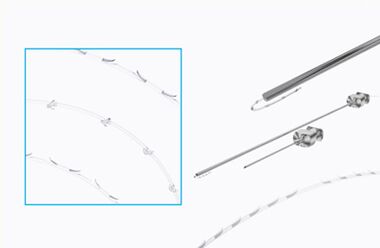
 - Rhinoplasty with threads.This method is used to correct the tip and wings of the nose.Its essence lies in the fact that through small punctures threads are inserted under the skin, giving the nose the desired shape.The procedure is performed under local anesthesia.The installed threads create a kind of frame for the fabrics and allow minor defects to be corrected.Already 2-3 days after cutting the ends of the threads, you can admire the final result.But many plastic surgeons are ambivalent about such manipulations, since there is a risk of thread breakage or scarring.
- Using a splint.A splint is a special device to improve the contour of the nose, made of durable plastic or plaster.With this device you can lift the tip of the nose, smooth a small hump, narrow the wings of the nose or restore its symmetry.This result is achieved thanks to the pressure of the splint on the cartilage tissue.
The rhinoplasty method with fillers is especially popular among patients, as it is considered the simplest, safest and has a minimum of contraindications.The durability of the correction depends largely on the type of filler used.Let's look at the main types of fillers used for non-surgical nose correction:
Biodegradable fillers.Over time, these medications are broken down into their simplest components and eliminated from the body.Such means include:
- Fillers based on hyaluronic acid;
- Fillers based on human or bovine collagen;
- Long-acting fillers.They dissolve slowly and can remain in the body for up to 3 years.Such preparations include gels based on lactic acid, polycaprolactone and calcium hydroxyapatite.
Biodegradable fillers.These are preparations based on polymeric synthetic gels (for example, silicone).The main difference between these biostable fillers is that they do not react chemically with compounds and substances in the human body and are not eliminated from it.
Autologous fillers– these are the patient's own fatty tissues, taken from any part of the body.The lipofilling procedure allows you to achieve the longest lasting effect and avoid allergic reactions.But this method has a disadvantage associated with a high risk of developing tissue fibrosis.Therefore, the use of lipofilling is extremely limited.
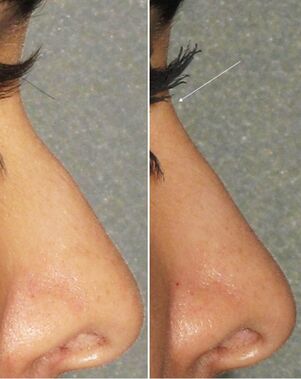
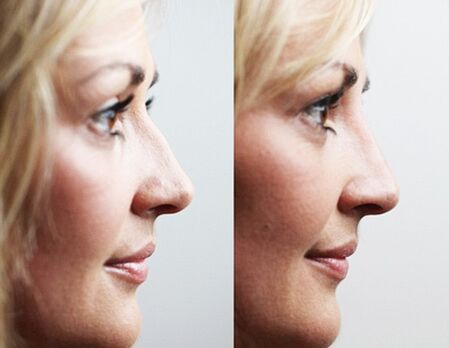
Non-surgical rhinoplasty technique: before and after photos
Before the procedure, the patient should consult with a dermatologist and therapist to find out possible contraindications.Then, at an appointment with a plastic surgeon, the volume of work to be performed is determined and the optimal method of performing the necessary manipulations and medications is selected.
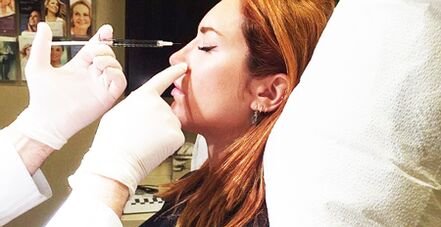
The procedure itself is performed on an outpatient basis and uses local anesthesia.The skin of the nose and cheeks is treated with an antiseptic solution and a special cream containing an anesthetic.After treatment, wait 10 to 15 minutes for the anesthetic to have the necessary effect and begin inserting fillers.
Plastic gels are injected into strictly defined and pre-designated points in a small volume.The entire procedure does not last long and lasts between 15 and 45 minutes.At the final stage, a special protective splint is applied to the nose, which will maintain the desired shape and protect the nose from injury.
After the procedure is completed, the patient can immediately go home and lead a normal lifestyle.The recovery period is very short and only takes one day.The final result will be visible 3-4 days after the procedure.The results that can be achieved with this method can be seen in the before and after photos.non-surgical rhinoplasty,presented on websites on the Internet or in brochures of cosmetology clinics.On average, the effect of non-surgical rhinoplasty lasts about a year.The procedure can be repeated in the future.
After the procedure: basic recommendations.
Immediately after completing the injections, it is recommended to apply cold to the treatment area.This simple measure will help prevent swelling and bruising.Sometimes, the day after the procedure, the patient is offered a corrective massage, which helps to better distribute the filler under the skin.After a few days, you will be able to lead a normal lifestyle, actively play sports, visit a bathhouse or sauna, and use optics.
Both during the rehabilitation period and in the future, the patient is advised to avoid possible nasal injuries by all means, otherwise not only the effect of the procedure will be neutralized, but also the threat of unwanted complications will arise (fibrosis, displacement of the implant).
Possible complications
Regardless of the surgeon's experience and the patient's compliance with all recommendations, complications may develop in some cases.
Short-term complications develop directly during the manipulations or immediately after their completion, but disappear on their own quite quickly.Such complications include:
- Redness, swelling in the filler injection area;
- Painful sensations in the injection area;
- Bruising in the treatment area;
- Lack of the desired effect (due to filler migration or incorrectly calculated drug dosage).
Long termComplications can appear immediately after the procedure or develop several months after the intervention.In this case, the following consequences are possible:
- The appearance of fibrosis in the gel implant area;
- Vascular embolism;
- Development of delayed allergic reactions;
- Violation of the shape of the nose due to the gravitational descent of the gel;
- Possible breakage of threads when correcting the nose with threads;
- Development of infected herpes.
Cosmetologists advise weighing the pros and cons before deciding on rhinoplasty.To avoid unpleasant consequences, it is necessary to undergo a complete examination before the procedure and evaluate the risk of possible complications.However, reviews of non-surgical rhinoplasty indicate that today this is the most optimal and safe method of nose correction for correcting minor defects.
Advantages and disadvantages of the method.
The main advantages of non-surgical rhinoplasty include:
- Painless procedure.There is no need for general anesthesia.To eliminate discomfort and pain, local anesthetics are sufficient.
- Implementation speed.The procedure lasts only 30 to 45 minutes, after which the patient can go home and lead a normal lifestyle.
- Short rehabilitation period.It takes less than a day and it is not necessary to perform additional manipulations or care in the treated area.
- Security.A small number of contraindications and an almost complete absence of side effects made this procedure the most popular.
- Availability.The quite reasonable cost of the method made it accessible to a wide range of consumers.
- Non-surgical rhinoplasty can be repeated.And if the result of the previous procedure does not completely satisfy the patient, a second correction can be performed after six months.
The disadvantages of nose correction without surgery include the following:
- If the dosage of the drug is selected incorrectly and errors are made during its administration, deformation of the nose may occur, which will have to be corrected surgically.
- Non-surgical nose rhinoplasty helps only with minor defects;In case of serious problems, using this method will be useless.
- Insufficient qualifications of the surgeon can lead to the development of unwanted complications and displacement of the filler, which will disrupt the shape of the nose.
- Certain medications (hormones) need to be administered in several stages, so the procedure lasts 2 to 3 weeks.
For those who are planning plastic surgery in the near future, experts do not recommend resorting to a non-surgical correction method.The fact is that with repeated injections, the nasal tissues lose their original shape and difficulties arise with blood supply.All this will significantly complicate surgical rhinoplasty.
Price
The cost of non-surgical nasal rhinoplasty depends on many factors: the individual characteristics of the patient, the medications used, the qualifications of the surgeon and the status of the cosmetology clinic.
Reviews
Review #1
More than a year ago I sought the services of cosmetologists to correct a small hump on my nose.I underwent non-surgical rhinoplasty, meaning I was injected with gel fillers.Before the procedure, my nose was treated with an anesthetic, so I felt no pain, but I was able to watch the progress of the procedure using a mirror.The medications were injected under the skin with a fine needle;all manipulations lasted only 20 minutes.After the procedure I was able to return home immediately.There were no side effects or complications.The shape of the nose suits me quite well, the effect still lasts.As soon as the effect of the gel ceases, the procedure will be repeated.
Review #2
To correct a slightly flat nose, I went to a cosmetology clinic and the specialist recommended introducing a special drug, an implant, instead of surgery.They injected me with a self-absorbing gel.
I was quite satisfied with the result, my nose acquired the correct shape and this effect lasted for a year and a half.The procedure itself was very fast, the clinic has experienced specialists, so everything went smoothly and there were no complications.
Review #3
The shape of my nose, or rather its tip, has always irritated me.It ruined its appearance, I always wanted to lift it up a little.Non-surgical rhinoplasty came to the rescue.They injected me with a hormonal drug.
I was satisfied with the result, the nose is now straight and the tip seems thinner and more elegant.The only negative is that the procedure takes a long time, since the medicine is injected in small portions.I had to have injections for about 3 weeks.